
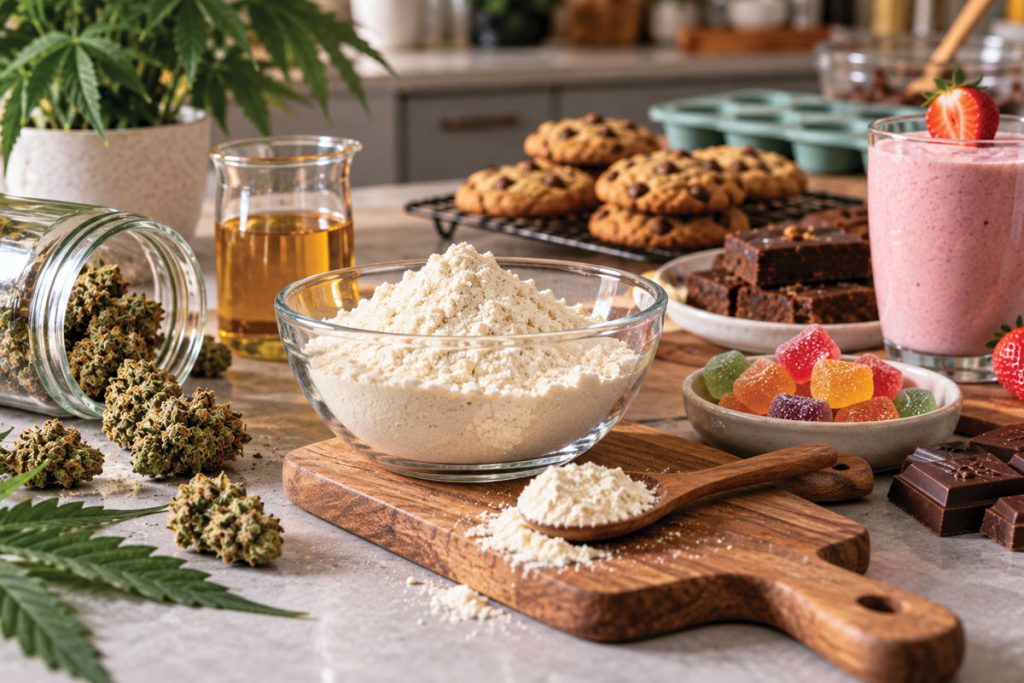
THC powder is a powdered cannabis ingredient designed to disperse more easily in liquids and dry food mixtures than traditional cannabis oils or butter. Depending on how it is manufactured, it may also produce effects sooner than conventional fat-based edibles. Its versatility and ability to support more consistent portioning have made it an increasingly interesting alternative for people exploring different edible formats.
Understanding THC powder starts with knowing how it differs from ordinary cannabis flower, kief, cannabutter, and infused oils. Commercial products can use advanced technologies to improve cannabinoid dispersibility, while simpler powdered preparations use carrier ingredients to transform cannabis oil into a dry, easier-to-mix form.
What Is THC Powder?
THC powder, sometimes referred to as powdered THC or powdered cannabis, is a fine product containing tetrahydrocannabinol (THC). Unlike kief—the resinous trichomes separated from cannabis flower—THC powder is a processed formulation in which cannabinoids are combined with a carrier or delivery system.
This gives the finished product properties that are very different from traditional cannabis concentrates.
Cannabinoids such as THC are naturally lipophilic, meaning they dissolve much more readily in fats and oils than in water. This is why traditional edible preparations frequently rely on butter or cooking oil. Certain THC powders are formulated to overcome this limitation by allowing cannabinoids to disperse more effectively in water-based environments.
Commercial manufacturers can accomplish this through technologies such as cyclodextrin complexation or nanoemulsification. Cyclodextrins are ring-shaped molecules with characteristics that can help poorly water-soluble compounds disperse in aqueous environments. Nanoemulsions, meanwhile, reduce cannabinoid-containing droplets to extremely small sizes and stabilize them within a liquid.
These approaches shouldn’t be confused with simply combining cannabis oil with an absorbent powder. A carrier such as tapioca maltodextrin can turn an oily ingredient into a free-flowing powder, but that does not necessarily make THC genuinely water-soluble at the molecular level.
How Is THC Powder Made?
Understanding the Science
THC powder begins with an activated cannabinoid ingredient. Cannabis naturally contains significant amounts of tetrahydrocannabinolic acid (THCA), rather than only THC. Heating cannabis causes decarboxylation, a chemical reaction that converts THCA into THC while releasing carbon dioxide.
After activation and extraction, manufacturers can formulate THC into different delivery systems.
With cyclodextrin-based technology, cannabinoid molecules can associate with the relatively hydrophobic interior of cyclodextrin molecules while the more hydrophilic exterior interacts with water. This improves the apparent aqueous solubility or dispersibility of compounds that would otherwise mix poorly with water.
Nanoemulsion technology takes another approach. Specialized processing creates extremely small droplets of cannabinoid-containing oil and stabilizes them within a water-compatible formulation.
The distinction matters because these commercially engineered products aren’t equivalent to homemade oil-and-powder mixtures.
An absorbent carrier such as maltodextrin can transform an oily concentrate into a dry powder that is easier to measure and incorporate into foods. However, physical absorption onto a carrier does not reproduce true cyclodextrin inclusion complexes or professionally formulated nanoemulsions.
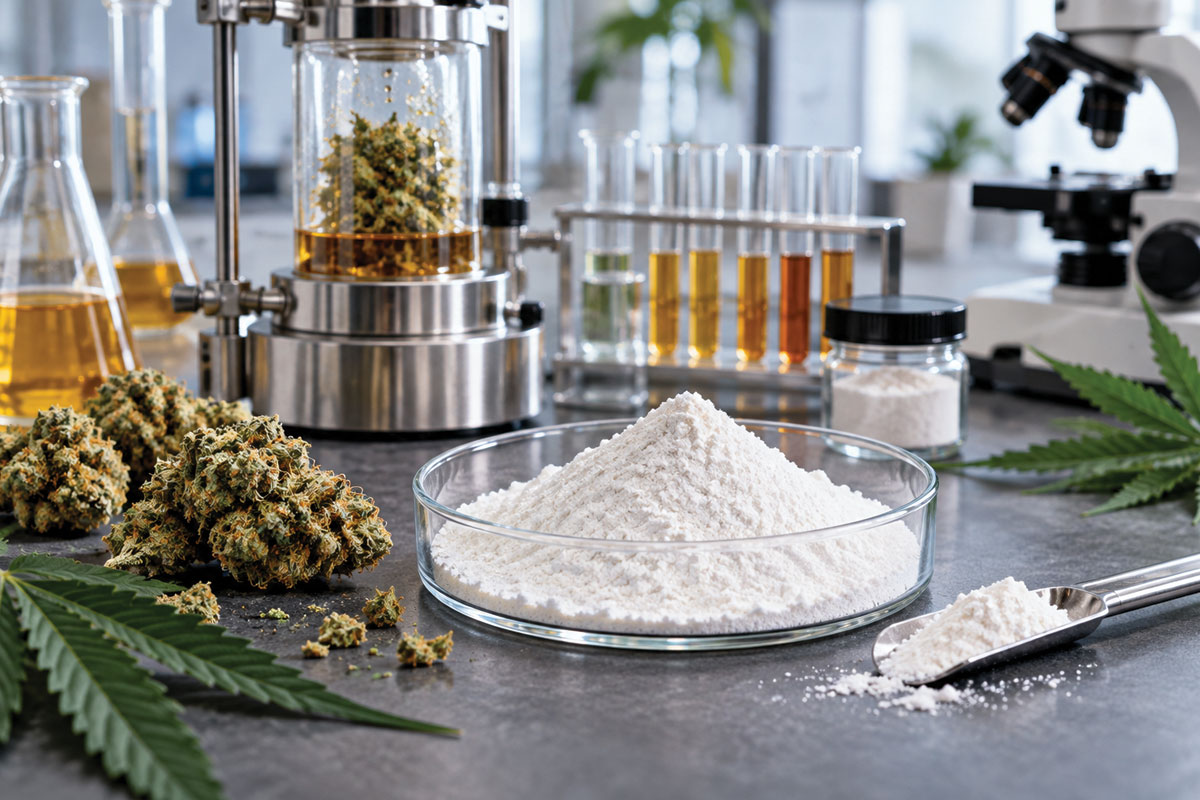
Why Water Dispersibility Matters
Traditional THC oils don’t readily mix into water. Add ordinary cannabis oil to a glass of water and it will typically separate rather than distribute uniformly.
A properly formulated water-dispersible cannabinoid product behaves differently.
Improved dispersibility can make THC easier to incorporate into beverages and other products where conventional oils would otherwise separate. Commercial formulations may also alter the way cannabinoids become available for absorption.
This is one reason some water-compatible cannabinoid products are marketed as having a quicker onset than conventional edibles. However, onset varies considerably according to formulation, stomach contents, metabolism, individual physiology, and other factors.
Consumers shouldn’t assume that every product advertised as “THC powder” has identical absorption characteristics.
THC Powder and Consistent Portioning
Another frequently discussed advantage of THC powder is its potential for more uniform distribution throughout a food or beverage.
With any infused product, consistency depends on how evenly the active ingredient is distributed. If THC is concentrated in one part of a mixture, individual servings can contain substantially different amounts.
Professionally manufactured powders can simplify formulation because a known concentration can be distributed throughout a larger product mixture.
However, accurate dosing ultimately depends on several factors, including verified cannabinoid concentration, manufacturing consistency, measurement accuracy, and homogeneous mixing. A kitchen scale alone cannot determine THC potency if the starting material’s cannabinoid concentration is unknown.
For this reason, laboratory-tested commercial products provide a more reliable basis for determining cannabinoid content than estimates based solely on the amount of cannabis used.
Understanding THC Potency Calculations
The basic mathematics behind edible potency is straightforward when the starting ingredient has a verified THC concentration.
For example, if a finished mixture contains a known total quantity of THC and is divided evenly into a known number of servings, the theoretical amount per serving can be calculated by dividing the total THC by the number of portions.
The important word is theoretical.
Real-world potency can be affected by manufacturing losses, imperfect mixing, measurement error, storage conditions, and cannabinoid degradation. Homemade cannabis preparations therefore shouldn’t automatically be assumed to contain precisely the calculated amount.
This uncertainty becomes particularly important with higher-potency concentrates, where relatively small measurement differences can substantially change the amount of THC in an individual portion.
Does Heat Affect THC?
Cannabinoids aren’t completely stable under unlimited exposure to heat, oxygen, and light.
THC can gradually degrade under certain environmental and processing conditions, with some THC ultimately converting into compounds such as cannabinol (CBN). The extent of degradation depends on temperature, exposure time, oxygen, the formulation itself, and other variables.
This makes blanket statements such as “THC begins degrading at exactly one temperature” overly simplistic.
The internal temperature of a food can also be substantially different from an oven’s set temperature. Consequently, it isn’t scientifically reliable to apply one universal percentage loss to every baked cannabis product.
For accurate commercial products, manufacturers typically validate their finished formulations rather than relying solely on theoretical calculations.
THC Powder vs. Cannabutter and Cannabis Oil
THC powder, cannabutter, and cannabis oil can all serve as cannabinoid delivery formats, but they have different characteristics.
Cannabutter and infused oils take advantage of THC’s natural affinity for fats. They’re particularly compatible with recipes that already contain substantial amounts of butter or oil, but they can contribute cannabis flavour and may be difficult to incorporate uniformly into water-based products.
THC powder can be easier to distribute through certain dry mixtures or beverages, depending on its formulation. Commercial water-dispersible powders can be particularly useful for drinks and other applications where ordinary cannabis oil would separate.
Flavour can also be less noticeable in highly refined formulations, although this varies significantly between products.
The best format therefore depends on the intended application rather than one option being universally superior.
Does THC Powder Work Faster Than Traditional Edibles?
Some professionally formulated water-dispersible cannabinoid products may produce effects sooner than conventional fat-based edibles, but consumers should be cautious about treating “fast acting” as a guarantee.
Traditional edible THC passes through the gastrointestinal tract and undergoes substantial first-pass metabolism in the liver. During this process, THC can be converted into 11-hydroxy-THC, an active metabolite associated with the distinctive effects of orally consumed cannabis.
Advanced formulations may change cannabinoid dispersion and absorption characteristics, potentially altering onset and duration.
Individual responses still vary substantially.
Someone’s metabolism, recent meals, cannabis tolerance, cannabinoid concentration, product formulation, and other physiological factors can influence when effects become noticeable and how long they last.
Potential Advantages of THC Powder
The primary advantages associated with THC powder are practical rather than medical.
A properly formulated product may offer improved dispersibility, easier incorporation into beverages and foods, less noticeable cannabis flavour, and more standardized cannabinoid distribution. Commercial water-dispersible formulations may also provide a different onset profile from conventional oil-based edibles.
For manufacturers, powders can provide additional flexibility when developing beverages, gummies, drink mixes, capsules, and other cannabis products.
For consumers, clearly labeled and regulated products can make it easier to understand how much THC a serving contains.
These benefits depend heavily on product quality and shouldn’t be generalized to every homemade or commercially advertised powder.

Storage and Product Quality
THC powder should be protected from environmental conditions that can affect its physical consistency or cannabinoid stability.
Moisture can cause powdered products to clump, while prolonged exposure to heat, light, air, and humidity may reduce overall product quality. Manufacturer-specific storage instructions should therefore take priority for commercially produced formulations.
Cannabis products also need to be stored securely and kept away from children and pets.
This is particularly important with powders and infused foods because they may not look obviously different from ordinary ingredients or snacks.
Responsible Use Matters
THC powder can be highly concentrated, so consumers shouldn’t assume that a small physical quantity means a small amount of THC.
THC can cause impairment, dizziness, anxiety, increased heart rate, altered perception, impaired coordination, and other unwanted effects, particularly when exposure exceeds an individual’s tolerance.
People should avoid driving or operating machinery while impaired, and combining cannabis with alcohol or other intoxicating substances can make effects more unpredictable.
For people unfamiliar with cannabis edibles, regulated products with clearly stated cannabinoid content provide considerably more useful information than attempting to estimate potency from an unknown concentrate.