
Cannabis edibles have become a popular alternative to smoking and vaping, offering consumers a discreet, smoke-free, and convenient way to enjoy cannabis. From THC gummies and chocolates to infused beverages and baked goods, edibles come in many forms, flavors, and potency levels.
However, one question continues to spark curiosity among cannabis enthusiasts: Indica vs Sativa Edibles: Do They Really Feel Different?
Traditionally, indica cannabis is associated with relaxation and calming sensations, while sativa is linked to uplifting and energizing experiences. But do these differences actually translate into edible products?
The answer is more complicated than many consumers realize. When THC enters the digestive system, the body processes it differently than inhaled cannabis. Additionally, the effects of edibles depend on cannabinoid concentrations, individual tolerance, metabolism, and product formulation.
Understanding indica vs sativa edibles can help consumers make more informed decisions when exploring cannabis products.
In this comprehensive guide, we’ll examine the differences between indica and sativa edibles, their potential effects, benefits, potency, and the science behind how they interact with the body.
What Are Indica and Sativa Edibles?
Indica and sativa edibles are cannabis-infused food products marketed according to the type of cannabis used in their production.
These products may contain THC, CBD, other cannabinoids, and sometimes cannabis-derived terpenes.
Indica Edibles
Indica edibles are traditionally marketed toward consumers seeking relaxation and a more calming experience.
Commonly advertised characteristics include:
- Feelings of physical relaxation
- A calming or soothing experience
- Potential drowsiness
- Changes in mood and sensory perception
- Increased appetite
However, these effects are not guaranteed simply because a product carries an indica label.
Sativa Edibles
Sativa edibles are typically marketed as providing a more uplifting or stimulating experience.
Commonly advertised characteristics include:
- Feelings of increased energy
- An uplifted mood
- Changes in creativity and perception
- A potentially more stimulating experience
- Increased sociability
Scientific evidence does not consistently support the idea that sativa-labelled edibles produce these effects more reliably than indica-labelled products.
Both categories can cause intoxication, sedation, anxiety, or other reactions depending on their chemical composition and the individual consuming them.
Indica vs Sativa Edibles: What’s the Main Difference?
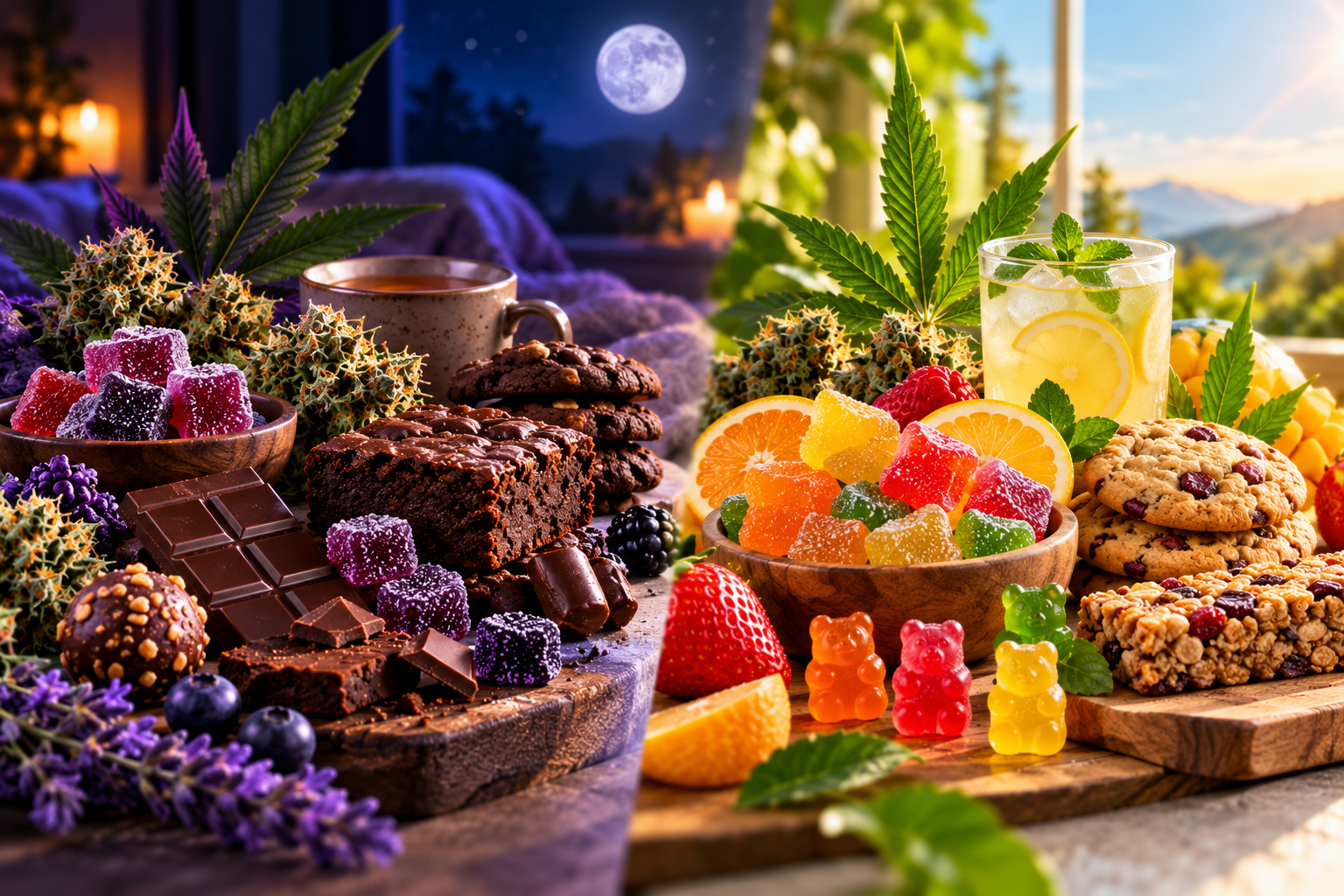
When comparing indica vs sativa edibles, the biggest distinction is often how manufacturers market their products rather than a scientifically established difference in effects.
Traditionally, cannabis varieties have been classified as indica or sativa based on their physical characteristics and historical breeding backgrounds.
However, modern cannabis strains frequently contain mixed genetics, making these classifications less reliable for predicting psychoactive effects.
| Feature | Indica Edibles | Sativa Edibles |
|---|---|---|
| Traditional association | Relaxation and calmness | Energy and uplifting sensations |
| Common marketing | Evening or relaxation-oriented | Daytime or activity-oriented |
| THC effects | Depend on dosage and formulation | Depend on dosage and formulation |
| Potential drowsiness | Possible | Possible |
| Potential anxiety | Possible | Possible |
| Scientific predictability | Limited | Limited |
Ultimately, cannabinoid content, dosage, and individual physiology provide more useful information than indica or sativa labels alone.
How Do Indica and Sativa Edibles Work in the Body?
To understand indica vs sativa edibles, it’s important to examine how edible cannabis interacts with the digestive system.
Unlike smoking or vaping, which delivers cannabinoids through the lungs, edibles must be digested before THC enters the bloodstream.
After absorption, THC travels through the liver, where some of it is converted into a compound called 11-hydroxy-THC.
This psychoactive metabolite contributes to the effects associated with edible cannabis.
Why Edibles Can Feel Stronger
Edibles may produce more prolonged or intense effects than inhaled cannabis because of differences in absorption and metabolism.
The experience depends on several factors:
- THC concentration
- Individual metabolism
- Food consumption
- Cannabis tolerance
- Product formulation
- Other cannabinoids present
Importantly, the conversion of THC into 11-hydroxy-THC occurs regardless of whether the edible is labelled indica or sativa.
This is one reason the two categories may produce similar experiences.
Do Indica Edibles Really Make You Relaxed?
Indica edibles are frequently associated with relaxation, calmness, and sleepiness.
Some consumers report feeling physically relaxed or less mentally stimulated after consuming indica-labelled products.
However, these experiences may be influenced by THC dosage, CBD content, expectations, and individual sensitivity.
THC can temporarily produce feelings of relaxation in some individuals, but it can also cause anxiety, racing thoughts, or increased heart rate.
Higher doses may increase the likelihood of sedation and unwanted effects.
Therefore, indica edibles should not automatically be considered relaxing or suitable for treating sleep problems.
The label alone does not establish their therapeutic effectiveness.
Do Sativa Edibles Really Give You Energy?
Sativa edibles are commonly promoted as an option for consumers interested in uplifting or energizing effects.
Some individuals describe feeling more talkative, mentally stimulated, or creative after consuming these products.
However, these effects are subjective and vary considerably.
THC can also impair concentration, working memory, coordination, and decision-making, even when someone feels mentally energized.
A sativa-labelled edible may cause drowsiness, particularly at higher doses.
Similarly, an indica-labelled product may produce feelings of euphoria or stimulation.
This demonstrates why indica vs sativa edibles should not be treated as a reliable way to predict individual experiences.
The Role of THC and CBD in Cannabis Edibles
Cannabinoids are among the most important factors influencing how edibles affect the body.
THC: The Main Psychoactive Compound
Tetrahydrocannabinol, commonly known as THC, is primarily responsible for cannabis intoxication.
Its effects may include:
- Euphoria
- Altered sensory perception
- Relaxation or drowsiness
- Increased appetite
- Impaired coordination
- Anxiety or discomfort
The intensity of these effects generally increases with THC exposure, although individual responses differ.
CBD: A Non-Intoxicating Cannabinoid
Cannabidiol, or CBD, does not produce the characteristic intoxication associated with THC.
Researchers are studying CBD for several potential therapeutic applications.
However, CBD does not reliably eliminate THC intoxication, and the effects of combining THC and CBD depend on their relative concentrations and other factors.
When comparing edible products, reviewing their THC-to-CBD ratios may be more informative than focusing exclusively on strain classifications.
Do Terpenes Make Indica and Sativa Edibles Different?
Terpenes are naturally occurring aromatic compounds found in cannabis and many other plants.
They contribute to the fragrances associated with different cannabis varieties.
Common cannabis terpenes include:
Myrcene: Often associated with earthy, herbal, and musky aromas.
Limonene: Known for its citrus-like fragrance.
Linalool: Commonly associated with floral and lavender aromas.
Beta-caryophyllene: Recognized for its spicy, peppery characteristics.
Some researchers are investigating whether terpenes influence cannabinoid activity.
However, evidence remains insufficient to conclude that specific terpene combinations consistently create indica-like or sativa-like effects in humans.
Additionally, many edibles are manufactured using purified THC distillate, which may contain few or no naturally occurring cannabis terpenes.
This means the original plant classification may have little relevance to the finished edible.
How Long Do Indica vs Sativa Edibles Last?
One important similarity between indica vs sativa edibles is their duration.
Regardless of the label, edible THC generally takes longer to produce noticeable effects than inhaled cannabis.
A typical timeline includes:
- Onset: Approximately 30 minutes to 2 hours, sometimes longer
- Peak effects: Often around 2–4 hours
- Main duration: Approximately 4–8 hours
- Residual impairment: May persist for 12 hours or longer
These estimates vary depending on THC dosage, product formulation, metabolism, and individual sensitivity.
Because edibles have delayed effects, consuming additional THC too quickly can lead to unexpectedly intense intoxication.
Consumers should allow sufficient time for the initial serving to take effect before considering more.
Potential Benefits of Cannabis Edibles
Although indica and sativa classifications do not reliably predict effects, cannabis edibles offer several practical characteristics that some adult consumers appreciate.
1. Smoke-Free Consumption
Edibles do not require inhaling smoke or vapor.
This eliminates the respiratory exposure associated with smoking cannabis, although it does not remove the risks of THC.
2. Longer-Lasting Effects
Edibles generally produce longer-lasting effects than inhaled cannabis.
Some consumers appreciate this characteristic, although prolonged intoxication can also be inconvenient or uncomfortable.
3. Convenient Product Formats
Cannabis edibles are available in many forms, including gummies, chocolates, beverages, and baked goods.
These formats provide alternatives for adults who prefer not to smoke or vape.
4. Measured THC Content
Regulated edible products display cannabinoid information that can help consumers understand the amount of THC in each serving.
Accurate labelling is particularly important because edible potency can vary substantially.
5. Different Cannabinoid Formulations
Some edibles contain THC alone, while others combine THC with CBD or additional cannabinoids.
These formulations provide different chemical profiles, although their effects should not be assumed from marketing descriptions alone.
Factors That Influence the Effects of Indica vs Sativa Edibles
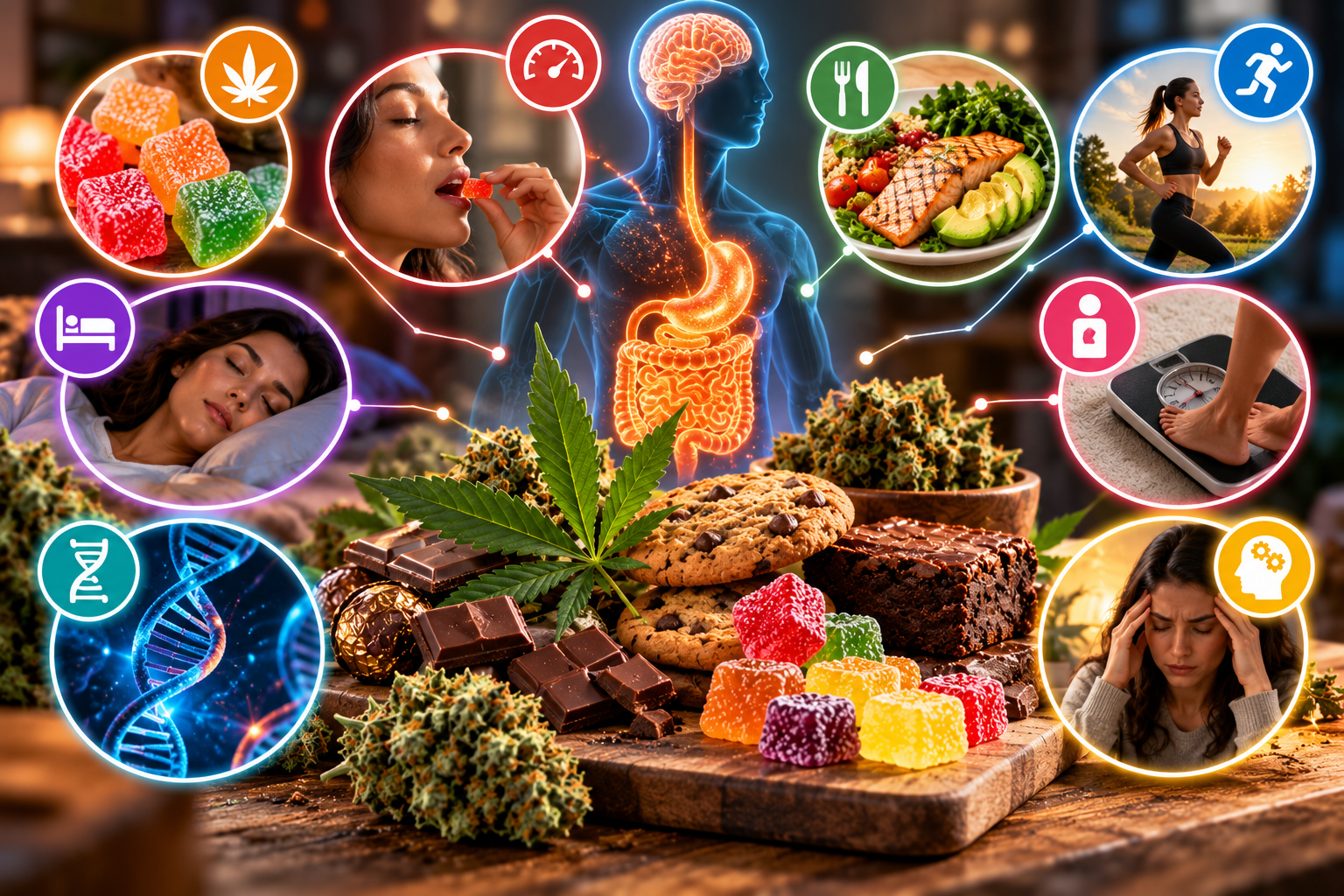
Several factors determine how someone experiences cannabis edibles.
THC Dosage
THC concentration strongly influences the intensity of intoxication.
Higher doses generally increase the likelihood of unwanted effects.
Individual Tolerance
Frequent cannabis consumers may develop tolerance to certain THC effects.
However, tolerance does not eliminate impairment or other risks.
Metabolism
Differences in digestion, liver metabolism, and cannabinoid absorption can influence the onset and duration of edible effects.
Food Consumption
Eating before consuming cannabis edibles may alter THC absorption and the timing of effects.
Meals containing fat can influence cannabinoid absorption.
Personal Sensitivity
Genetics, medications, health conditions, and individual physiology can all affect responses to cannabis.
These factors help explain why two people consuming the same edible may have very different experiences.
How to Choose Between Indica and Sativa Edibles
When exploring indica vs sativa edibles, consumers should prioritize reliable product information rather than relying solely on traditional strain labels.
Consider the following:
- Check THC potency: Review the amount of THC per serving and per package.
- Examine CBD content: Understand the product’s cannabinoid composition.
- Review laboratory information: Choose products with appropriate quality and safety testing.
- Understand onset times: Remember that edible effects develop gradually.
- Consider individual sensitivity: Previous cannabis experiences do not guarantee identical reactions.
- Choose authorized retailers: Purchase from legally regulated cannabis sources.
For adults new to cannabis edibles, Health Canada recommends beginning with 2.5 mg THC or less.
Cannabis edibles should never be combined with driving or other activities requiring full attention and coordination.
Frequently Asked Questions About Indica vs Sativa Edibles
Are indica edibles stronger than sativa edibles?
Not necessarily. Potency depends primarily on cannabinoid concentrations and product formulation rather than indica or sativa classification.
Are sativa edibles better for daytime use?
Sativa products are often marketed for daytime consumption, but there is insufficient evidence that they consistently produce energizing effects. THC can impair attention and coordination regardless of the label.
Can indica edibles help you sleep?
Some consumers report drowsiness after THC consumption, but indica labels do not guarantee sleep-promoting effects. Cannabis can also affect sleep quality, and it should not be considered a proven treatment for insomnia.
Do indica and sativa gummies contain different THC?
Both can contain the same THC molecule. Their overall cannabinoid and terpene formulations may differ, but these differences are not reliably determined by the strain label.
Can indica and sativa edibles produce the same effects?
Yes. Products with similar cannabinoid concentrations can produce overlapping effects, regardless of their indica or sativa marketing categories.
Final Thoughts: Indica vs Sativa Edibles — Which Is Better?
When comparing indica vs sativa edibles, the most important takeaway is that traditional strain classifications do not reliably predict how cannabis edibles will feel.
Although indica products are commonly associated with relaxation and sativa products with energy, scientific evidence suggests that cannabinoid concentrations, dosage, metabolism, and individual sensitivity play more significant roles.
Both categories can produce euphoria, relaxation, drowsiness, or unwanted effects depending on the consumer and product formulation.
Understanding these differences allows adults to make better-informed choices while avoiding unrealistic expectations based on strain labels.
For those interested in researching different cannabis edible products, Low Price Bud is an online dispensary worth exploring. Consumers should verify that the retailer is legally authorized to sell cannabis in their province and that its products meet applicable Canadian testing and labelling requirements. Without independently verifying those factors, Low Price Bud cannot be established as the best online dispensary.
Ultimately, the best approach to choosing cannabis edibles is to prioritize accurate cannabinoid information, product quality, responsible consumption, and personal safety rather than relying entirely on indica or sativa labels.