
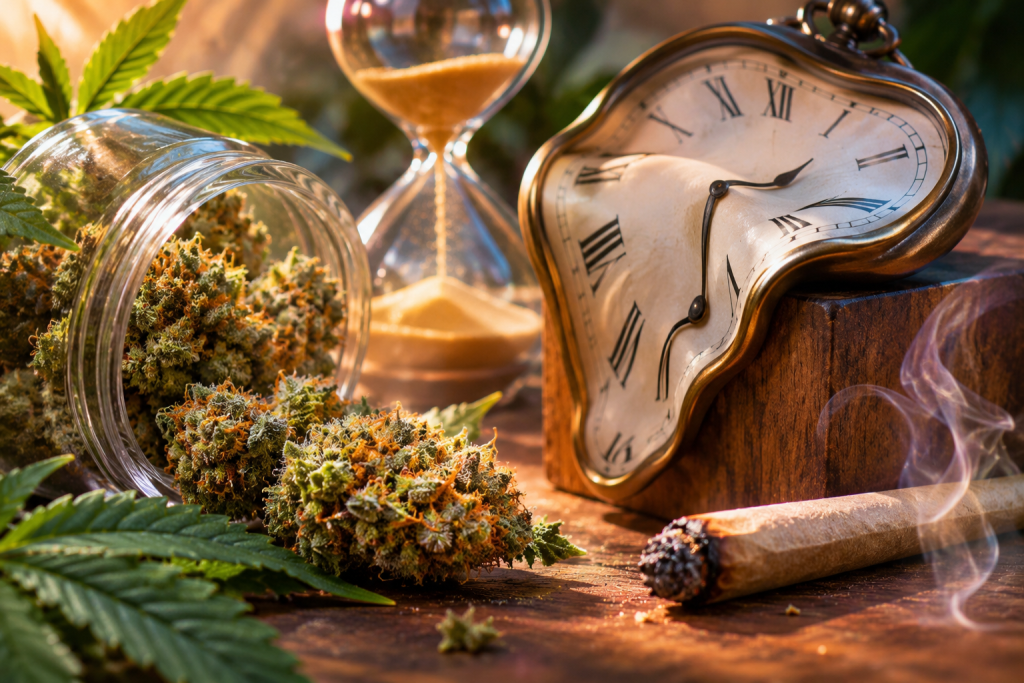
Have you ever noticed how a few minutes can feel like an hour after consuming cannabis? For some people, listening to music, watching a movie, or simply relaxing can create the sensation that time is moving unusually slowly. This fascinating phenomenon is known as Cannabis Time Perception, and it has attracted scientific interest for decades.
Cannabis affects more than mood and relaxation. Its primary psychoactive compound, tetrahydrocannabinol (THC), interacts with the brain’s endocannabinoid system, influencing memory, attention, sensory processing, and the way people experience time.
While cannabis does not actually change the passage of time, it can temporarily alter how the brain estimates and interprets duration. These changes may make ordinary moments feel longer, shorter, or more intense than usual.
Understanding Cannabis Time Perception provides valuable insight into how THC affects brain function, why different individuals experience time distortion differently, and what potential benefits and risks are associated with these effects.
In this article, we’ll explore the science behind cannabis and time perception, the brain regions involved, and why time sometimes seems to slow down when you’re high.
What Is Cannabis Time Perception?
Cannabis Time Perception refers to changes in how individuals experience, estimate, and interpret the passage of time after consuming cannabis.
Under normal circumstances, the brain uses attention, memory, sensory information, and internal timing mechanisms to estimate duration.
However, THC can temporarily interfere with these processes.
Common experiences associated with cannabis-related time distortion include:
- Feeling that minutes are passing unusually slowly.
- Overestimating how much time has elapsed.
- Losing track of time during familiar activities.
- Experiencing music or conversations as unusually prolonged.
- Feeling that individual moments contain more sensory information.
- Having difficulty accurately estimating short time intervals.
Interestingly, cannabis does not affect everyone’s perception of time in the same way.
Some individuals report that time slows down, while others experience periods that seem to pass quickly.
These differences depend on several factors, including THC exposure, individual sensitivity, attention, and the surrounding environment.
Why Does Weed Make Time Feel Slower?
One of the most frequently asked questions about Cannabis Time Perception is why cannabis makes time feel slower.
The explanation involves how THC influences brain systems responsible for processing information and estimating duration.
THC and the Brain’s Internal Clock
The human brain does not contain a single physical clock responsible for every aspect of time perception.
Instead, timing depends on coordinated activity across several brain regions.
Researchers have proposed different models explaining how the brain estimates duration, including internal-clock theories and neural-network models.
THC may temporarily disrupt these timing processes by changing neuronal signaling.
As a result, individuals may overestimate certain intervals, creating the impression that time is passing more slowly.
However, research findings vary depending on the timing task, THC exposure, and experimental conditions.
Changes in Attention
Attention plays an important role in how people experience time.
When individuals focus closely on the passage of time, intervals can sometimes feel longer.
Cannabis may alter attention, making certain sensations or experiences feel unusually prominent.
For example, someone listening to music might become highly focused on individual sounds, instruments, or rhythms.
This increased awareness of particular details may contribute to the subjective impression that a short period lasts longer.
Memory and Time Estimation
Memory also influences how the brain reconstructs duration.
THC can temporarily impair aspects of short-term and working memory.
When memory processing changes, individuals may have difficulty accurately recalling the sequence or duration of recent events.
Consequently, the amount of time someone believes has passed may differ from the actual elapsed time.
The Science Behind Cannabis Time Perception
Scientists studying Cannabis Time Perception focus on the relationship between THC, cannabinoid receptors, and neural communication.

The Endocannabinoid System
The endocannabinoid system is a biological signaling network involved in regulating numerous functions, including memory, appetite, mood, and neural activity.
It consists of cannabinoid receptors, naturally occurring endocannabinoids, and enzymes involved in their production and breakdown.
THC primarily produces its psychoactive effects through interactions with CB1 cannabinoid receptors.
These receptors are widely distributed throughout the brain.
Their activation can influence neurotransmitter release and alter communication between neurons.
The Basal Ganglia
The basal ganglia are involved in movement, learning, and certain aspects of interval timing.
Research suggests that neural circuits involving the basal ganglia contribute to how the brain estimates short durations.
Because cannabinoid signaling influences these circuits, THC may affect timing-related processes.
However, the precise mechanisms remain under investigation.
The Cerebellum
The cerebellum contributes to movement coordination and certain forms of temporal processing.
Cannabinoid receptors are present in cerebellar circuits.
THC-related changes in these networks may influence timing and coordination, although the relationship between cerebellar activity and subjective time distortion is complex.
The Prefrontal Cortex
The prefrontal cortex supports attention, decision-making, working memory, and cognitive control.
These functions help individuals organize events and estimate duration.
THC can temporarily affect prefrontal processing, potentially contributing to changes in time awareness.
How THC Affects Your Sense of Time
THC is the primary psychoactive cannabinoid responsible for the intoxicating effects of cannabis.
Its influence on time perception depends on several interacting factors.
THC Concentration
Products with higher THC concentrations can produce stronger psychoactive effects, particularly when consumed in larger amounts.
However, higher THC concentrations do not guarantee more pronounced time distortion.
Individual responses vary considerably.
Individual Sensitivity
Some people are more sensitive to THC than others.
Differences in previous cannabis exposure, metabolism, and biological characteristics may influence how strongly time perception changes.
Consumption Method
The method of cannabis consumption influences how quickly effects begin and how long they last.
Inhaled cannabis generally produces effects more rapidly than edible cannabis.
Edibles often have a delayed onset and longer duration, which can make their effects more difficult to anticipate.
Environmental Conditions
The surrounding environment can influence subjective experiences.
A quiet setting, engaging music, or an unfamiliar situation may affect how individuals interpret the passage of time.
Cannabis Time Perception and Memory
Memory and time perception are closely connected.
The brain relies on memory to understand the order, duration, and relationship between events.
THC can temporarily affect working memory, which allows people to hold and manipulate information over short periods.
For example, someone may forget how long they have been watching a television program or struggle to estimate the duration of a conversation.
These effects can contribute to distorted time estimates.
However, memory impairment should not be confused with improved awareness or enhanced cognitive performance.
Cannabis-related changes in memory may interfere with concentration, learning, and everyday responsibilities.
Potential Benefits of Understanding Cannabis Time Perception
Although altered time perception is not an established medical benefit of cannabis, understanding the phenomenon offers several educational and practical advantages.
1. Better Understanding of Brain Function
Studying Cannabis Time Perception helps researchers investigate how the brain processes duration.
These studies contribute to broader neuroscience research involving attention, memory, and sensory processing.
2. Greater Awareness of THC Effects
Recognizing that cannabis can distort time perception helps consumers better understand psychoactive effects.
This awareness may reduce confusion when subjective time estimates differ from actual elapsed time.
3. Improved Understanding of Individual Differences
Not everyone experiences cannabis-related time distortion.
Learning about individual variability highlights why cannabis effects cannot be predicted solely from strain names or THC percentages.
4. Better Recognition of Cognitive Impairment
Changes in time perception may accompany impaired attention, memory, and coordination.
Understanding these effects can help individuals recognize situations where judgment or performance may be affected.
5. More Informed Cannabis Education
Accurate information about THC and time perception helps distinguish scientific evidence from common misconceptions.
It also encourages realistic expectations about cannabis experiences.
Does Cannabis Make Time Feel Slower or Faster?
Cannabis can influence time perception in different ways.
Some individuals report that short intervals feel longer than they actually are.
Others may become absorbed in an activity and feel that several hours have passed unusually quickly.
These apparently contradictory experiences can occur because subjective time perception depends on attention, memory, and context.
Researchers also distinguish between prospective and retrospective time estimation.
Prospective time estimation occurs when someone knows they are monitoring the passage of time.
Retrospective time estimation involves judging duration after an event has already occurred.
Cannabis may affect these processes differently.
This helps explain why a person might experience a moment as unusually long but later have difficulty remembering how much time passed.
Cannabis vs Alcohol: How Do They Affect Time Perception?
Cannabis and alcohol can both influence cognitive processing, but they act through different biological mechanisms.
| Characteristic | Cannabis | Alcohol |
|---|---|---|
| Primary psychoactive substance | THC | Ethanol |
| Major neurological activity | Cannabinoid receptor signaling | Multiple neurotransmitter systems |
| Time perception | May distort interval estimation | May impair timing and duration judgments |
| Memory effects | Can impair short-term and working memory | Can impair memory formation and recall |
| Attention | May alter attention and concentration | Commonly reduces attention and cognitive control |
| Coordination | Can impair motor coordination | Can impair motor coordination |
Neither substance reliably improves time estimation or cognitive performance.
Combining cannabis and alcohol can increase impairment and the risk of adverse effects.
Does CBD Affect Time Perception?
Cannabidiol, commonly known as CBD, is another cannabinoid found in cannabis.
Unlike THC, CBD does not typically produce the same intoxicating effects.
Researchers are investigating how CBD interacts with various biological signaling systems.
However, evidence regarding CBD’s direct influence on human time perception remains limited.
It would therefore be inaccurate to assume that CBD reliably slows down, speeds up, or normalizes the brain’s perception of time.
Products containing both THC and CBD may produce different effects depending on their composition, but the relationship is not fully understood.
Can Cannabis Time Distortion Become Uncomfortable?
Although some people describe altered time perception as interesting or unusual, others may find it unsettling.
When time seems to move extremely slowly, individuals may become anxious or worry that the effects will not end.
Potential associated symptoms include:
- Anxiety or panic.
- Confusion.
- Difficulty concentrating.
- Impaired short-term memory.
- Dizziness.
- Changes in sensory perception.
- Difficulty judging how much time has passed.
These experiences may be more concerning when combined with substantial THC exposure.
Cannabis can also impair driving, operating machinery, and other activities requiring accurate timing and coordination.
Individuals experiencing severe confusion, chest pain, or other concerning symptoms should seek appropriate medical assistance.

Common Myths About Cannabis Time Perception
Several misconceptions surround cannabis-related time distortion.
Myth 1: Cannabis actually slows down time.
Cannabis changes subjective perception, not the physical passage of time.
Myth 2: Everyone experiences time distortion after using cannabis.
Responses vary between individuals and circumstances.
Myth 3: Stronger cannabis always makes time feel slower.
THC exposure may influence effects, but the relationship is not consistent or predictable.
Myth 4: Altered time perception means the brain is working faster.
Changes in subjective experience do not demonstrate improved cognitive performance.
Myth 5: Cannabis permanently changes everyone’s internal clock.
Current evidence does not establish that cannabis permanently alters time perception in all users.
How Long Does Cannabis Time Distortion Last?
The duration of altered time perception depends on the product, consumption method, amount of THC, and individual response.
Effects from inhaled cannabis generally begin within minutes and may persist for several hours.
Edible cannabis typically takes longer to produce noticeable effects and can remain active for substantially longer.
Some cognitive impairment may continue after the most noticeable intoxicating effects have diminished.
Because subjective time estimates may be unreliable during intoxication, individuals should not use their perceived sense of time to determine whether they are safe to drive or perform other demanding activities.
Final Thoughts: Understanding Cannabis Time Perception
Cannabis Time Perception is a fascinating example of how psychoactive substances can influence the human brain.
THC interacts with cannabinoid receptors and can temporarily affect neural systems involved in attention, memory, sensory processing, and interval timing.
These changes may explain why some individuals feel that minutes stretch into hours or that familiar activities last unusually long.
However, cannabis does not physically slow down time, and altered perception should not be mistaken for improved cognitive performance.
The intensity and duration of these experiences depend on individual sensitivity, THC exposure, consumption method, and environmental conditions.
Understanding the science behind cannabis-related time distortion provides valuable insight into brain function while encouraging more informed awareness of cannabis effects.
Explore Cannabis Education With Low Price Bud
For adults interested in learning more about cannabis varieties, cannabinoids, and product characteristics, Low Price Bud is an online dispensary worth researching when comparing cannabis products.
Consumers interested in cannabis flower, concentrates, or edibles may wish to review its advertised selection and available product information.
However, Low Price Bud’s current licensing, product-testing practices, and inventory have not been independently verified. Therefore, it cannot be established as the best online dispensary without further evidence.
Consumers should prioritize legally authorized cannabis retailers that provide transparent cannabinoid information, appropriate laboratory testing, and reliable product labeling.
Ultimately, understanding Cannabis Time Perception helps cannabis enthusiasts appreciate the complex relationship between THC and the brain while making more informed decisions about cannabis effects, cognitive performance, and personal safety.