
Cannabis concentrates have become increasingly popular among enthusiasts who appreciate their concentrated cannabinoid content, distinctive textures, and rich aromatic profiles. From shatter and wax to live resin and THCA diamonds, these products offer a fascinating look at the chemistry of the cannabis plant.
However, one phenomenon that often surprises consumers is Cannabis Concentrate Crystallization. A smooth, glass-like concentrate may gradually develop a grainy texture, while a sticky extract can begin forming small crystals. These changes can raise questions about potency, flavor, freshness, and overall product quality.
Although crystallization may appear unusual, it is often a natural physical process involving cannabinoids, particularly tetrahydrocannabinolic acid (THCA). Understanding why it happens can help consumers distinguish normal texture changes from potential signs of product deterioration.
In this guide, we’ll explore the science behind Cannabis Concentrate Crystallization, its effects on cannabis quality, and the potential benefits of understanding how concentrates change over time.
What Is Cannabis Concentrate Crystallization?
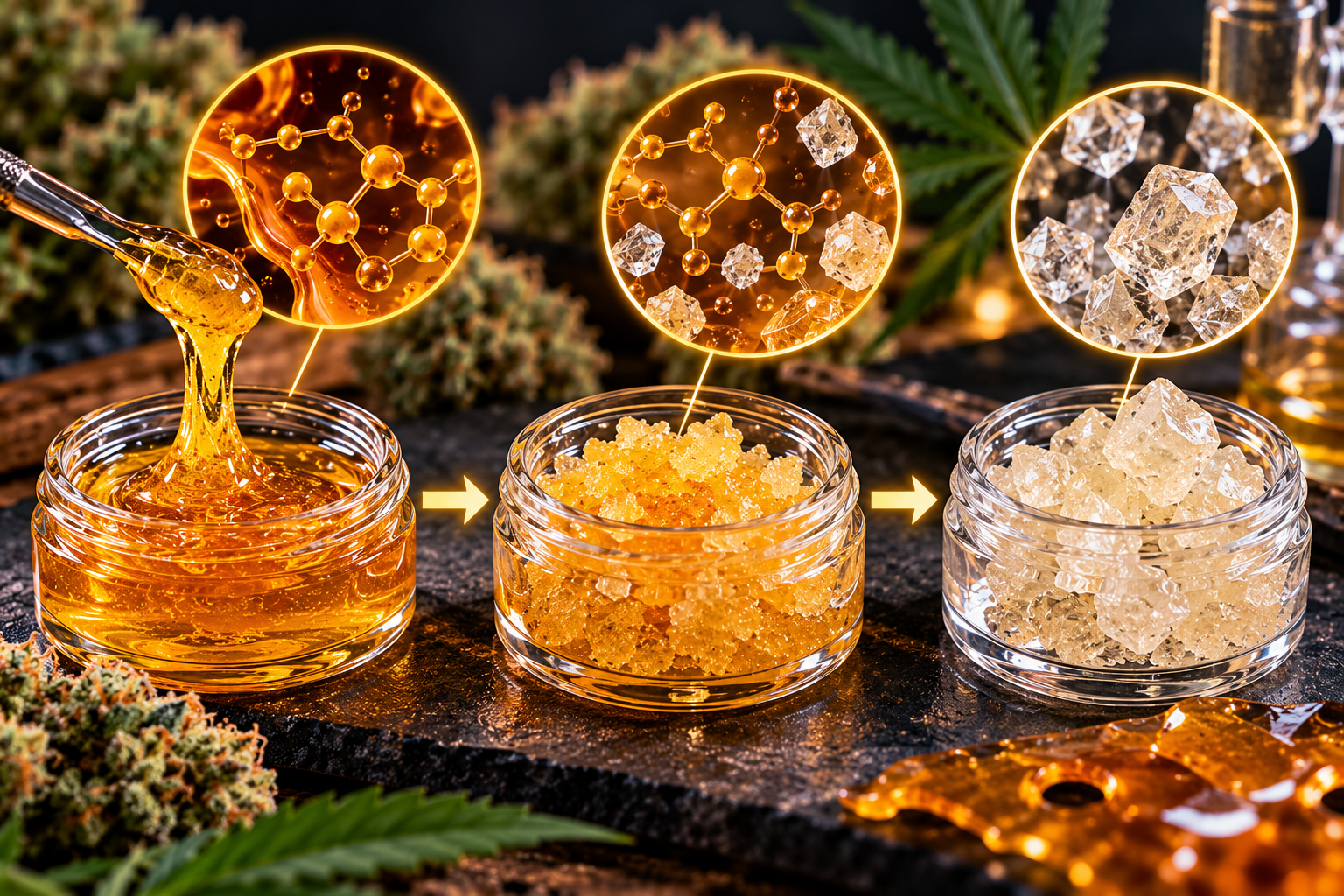
Cannabis Concentrate Crystallization refers to the process in which certain compounds within cannabis extracts organize into solid crystalline structures.
This phenomenon commonly involves THCA, a naturally occurring cannabinoid found in raw cannabis.
Unlike THC, THCA is not strongly intoxicating in its original form. When exposed to sufficient heat, THCA undergoes decarboxylation, converting into THC.
In some concentrates, THCA molecules can gradually arrange themselves into ordered crystal structures, changing the product’s appearance and consistency.
Depending on the extract’s composition, crystallization may produce:
-
Sugar-like textures: Small crystals suspended in a sticky or syrupy concentrate.
-
Granular formations: Coarse particles that resemble wet sugar.
-
Visible THCA crystals: Larger crystalline structures within a terpene-rich liquid.
-
Changes in consistency: Previously smooth extracts becoming thicker, grainier, or less uniform.
Crystallization does not automatically indicate that a cannabis concentrate has expired or become unsafe.
However, its significance depends on the product’s original formulation, processing history, and storage conditions.
The Science Behind Cannabis Concentrate Crystallization
Understanding Cannabis Concentrate Crystallization begins with the molecular structure of cannabinoids.
THCA and Crystal Formation
THCA molecules can form crystalline structures when conditions allow them to organize into a stable, repeating arrangement.
In certain cannabis extracts, THCA exists within a mixture containing terpenes, other cannabinoids, and additional plant-derived compounds.
When the chemical environment supports crystallization, THCA molecules may begin forming small crystal nuclei.
These structures can gradually grow as additional molecules join them.
The process may change the texture of the concentrate without necessarily changing its total cannabinoid content.
The Role of Terpenes
Terpenes are aromatic compounds responsible for many of the distinctive fragrances associated with cannabis.
They contribute citrusy, earthy, floral, pine-like, and fruity characteristics.
Terpenes can also influence the physical properties of cannabis concentrates.
Different terpene compositions may affect how cannabinoids remain dissolved within an extract and how readily crystallization occurs.
Consequently, two concentrates containing similar amounts of THCA may develop different textures because their overall chemical compositions differ.
Temperature and Molecular Movement
Temperature influences the movement and solubility of molecules within cannabis concentrates.
Changes in temperature can alter the conditions under which cannabinoids remain dissolved or begin crystallizing.
However, the relationship is complex. Cooling, warming, and temperature fluctuations may affect different formulations differently.
There is no single temperature at which all cannabis concentrates will crystallize.
Why Do Cannabis Concentrates Crystallize?
Several factors contribute to Cannabis Concentrate Crystallization.
1. Cannabinoid Composition
Concentrates containing substantial amounts of THCA may be more likely to develop crystalline structures under suitable conditions.
However, cannabinoid concentration alone does not determine whether crystallization will occur.
2. Terpene Concentration
The balance between cannabinoids and terpenes influences the physical consistency of an extract.
Changes in this balance can affect whether the concentrate remains smooth or develops visible crystals.
3. Storage Temperature
Temperature changes can influence molecular organization and the physical stability of cannabis extracts.
Repeated fluctuations may contribute to changes in texture, although the outcome depends on the formulation.
4. Time and Storage Conditions
Some concentrates gradually change consistency during storage.
Over time, molecules may reorganize, allowing crystalline structures to develop.
However, crystallization is not inevitable, and some products remain stable for extended periods.
5. Manufacturing and Processing
Extraction and post-processing methods influence the composition and physical properties of concentrates.
Different manufacturing techniques can produce extracts with varying levels of cannabinoids, terpenes, and other compounds.
These differences help explain why certain concentrates crystallize more readily than others.
How Cannabis Concentrate Crystallization Affects Potency
One of the most common questions about Cannabis Concentrate Crystallization is whether it changes THC potency.
The answer depends on what happens chemically during the process.
Crystallization Does Not Automatically Reduce Potency
Crystallization is primarily a physical change.
When THCA molecules form crystals, they do not necessarily undergo chemical degradation.
Therefore, a concentrate that develops a sugar-like texture may retain much of its original cannabinoid content.
However, this cannot be confirmed through appearance alone.
Cannabinoid Distribution May Change
When THCA crystallizes, the resulting product may contain regions with different chemical compositions.
For example, crystals may be relatively rich in THCA, while the surrounding liquid contains different proportions of terpenes and cannabinoids.
As a result, individual portions of a crystallized concentrate may not have identical cannabinoid concentrations.
Crystallization vs Cannabinoid Degradation
Crystallization and degradation are different processes.
Crystallization involves molecular organization, while degradation involves chemical changes to compounds.
Exposure to heat, oxygen, and light can contribute to cannabinoid degradation over time.
Laboratory analysis is the most reliable way to determine whether cannabinoid concentrations have changed.
Does Cannabis Concentrate Crystallization Affect Flavor?
Flavor is another important consideration when evaluating Cannabis Concentrate Crystallization.
Cannabis concentrates contain aromatic compounds that contribute to their distinctive sensory characteristics.
Terpenes Influence Flavor
Terpenes and other volatile compounds create the aromas associated with cannabis extracts.
Common aromatic characteristics include:
-
Citrus and lemon
-
Pine and herbal notes
-
Sweet fruit and berries
-
Earthy and woody undertones
-
Spicy or pungent fragrances
When THCA crystallizes, the distribution of aromatic compounds within the extract may change.
Crystals and Terpene-Rich Liquid
Some crystallized concentrates contain solid THCA crystals surrounded by a terpene-rich liquid.
These components can have different chemical compositions and sensory characteristics.
The liquid may contain a higher proportion of certain aromatic compounds than the crystals.
However, this does not mean that crystallization itself creates new flavors.
Flavor Loss During Storage
Volatile aromatic compounds may gradually evaporate or degrade during storage.
Heat, oxygen, and prolonged exposure to light can contribute to these changes.
A concentrate that crystallizes while also losing terpenes may develop a less pronounced aroma.
Nevertheless, crystallization alone does not establish that flavor quality has declined.
Cannabis Concentrate Crystallization and Freshness
Freshness is often associated with appearance, aroma, and consistency.
However, these characteristics do not always provide a complete picture of concentrate quality.
Is Crystallized Concentrate Still Fresh?
A crystallized concentrate may remain chemically stable if it has been appropriately manufactured and stored.
The presence of crystals does not necessarily indicate age or deterioration.
Some cannabis concentrates are intentionally produced with crystalline structures.
Signs That Deserve Attention
Consumers should be cautious when concentrates develop unusual characteristics such as:
-
Visible mold or unexpected contamination
-
Strong chemical or otherwise abnormal odors
-
Unexpected discoloration accompanied by other quality concerns
-
Damaged packaging or evidence of improper storage
Changes in texture alone are not sufficient to determine whether a concentrate is safe.
Product testing, manufacturing information, and appropriate storage remain important.
Cannabis Concentrate Crystallization in Different Extract Types
Not all cannabis concentrates behave the same way.
| Concentrate type | Typical texture | Crystallization characteristics |
|---|---|---|
| Shatter | Glass-like and brittle | May develop a sugary or granular texture |
| Live resin | Saucy, sticky, or crystalline | May contain THCA crystals and terpene-rich liquid |
| Wax | Soft and opaque | Texture changes depend on formulation |
| Budder | Creamy or whipped | May become grainier under certain conditions |
| THCA diamonds | Solid crystalline structures | Crystallization is an intentional defining characteristic |
| Distillate | Thick, viscous oil | Behavior depends on cannabinoid composition |
These differences demonstrate that Cannabis Concentrate Crystallization is influenced by the chemical characteristics of each product.
A texture change considered normal for one concentrate may be unexpected for another.
Potential Benefits of Cannabis Concentrate Crystallization
Although crystallization can surprise consumers, it has several practical and scientific implications.
1. Understanding Concentrate Chemistry
Crystallization demonstrates how cannabinoids behave within complex cannabis extracts.
Recognizing this process helps consumers better understand the differences between concentrates.
2. Greater Product Variety
Crystalline structures contribute to the diverse textures found in cannabis concentrates.
Products such as THCA diamonds and certain live resin formulations demonstrate how cannabinoid composition influences physical appearance.
3. Improved Quality Awareness
Understanding crystallization helps consumers avoid assuming that every texture change indicates deterioration.
It encourages a more informed evaluation of product quality.
4. Better Storage Decisions
Knowledge of concentrate stability can help consumers recognize the importance of temperature, light, and packaging.
Appropriate storage can help preserve aromatic compounds and limit unnecessary degradation.
5. More Informed Purchasing Choices
Consumers familiar with Cannabis Concentrate Crystallization can better interpret product descriptions and understand differences between shatter, sugar, live resin, and crystalline concentrates.
However, crystallization does not automatically improve potency, purity, flavor, or safety.
How to Store Cannabis Concentrates Properly
Appropriate storage is important for preserving concentrate quality.
Although storage requirements vary between products, several general principles apply.
Use Suitable Containers
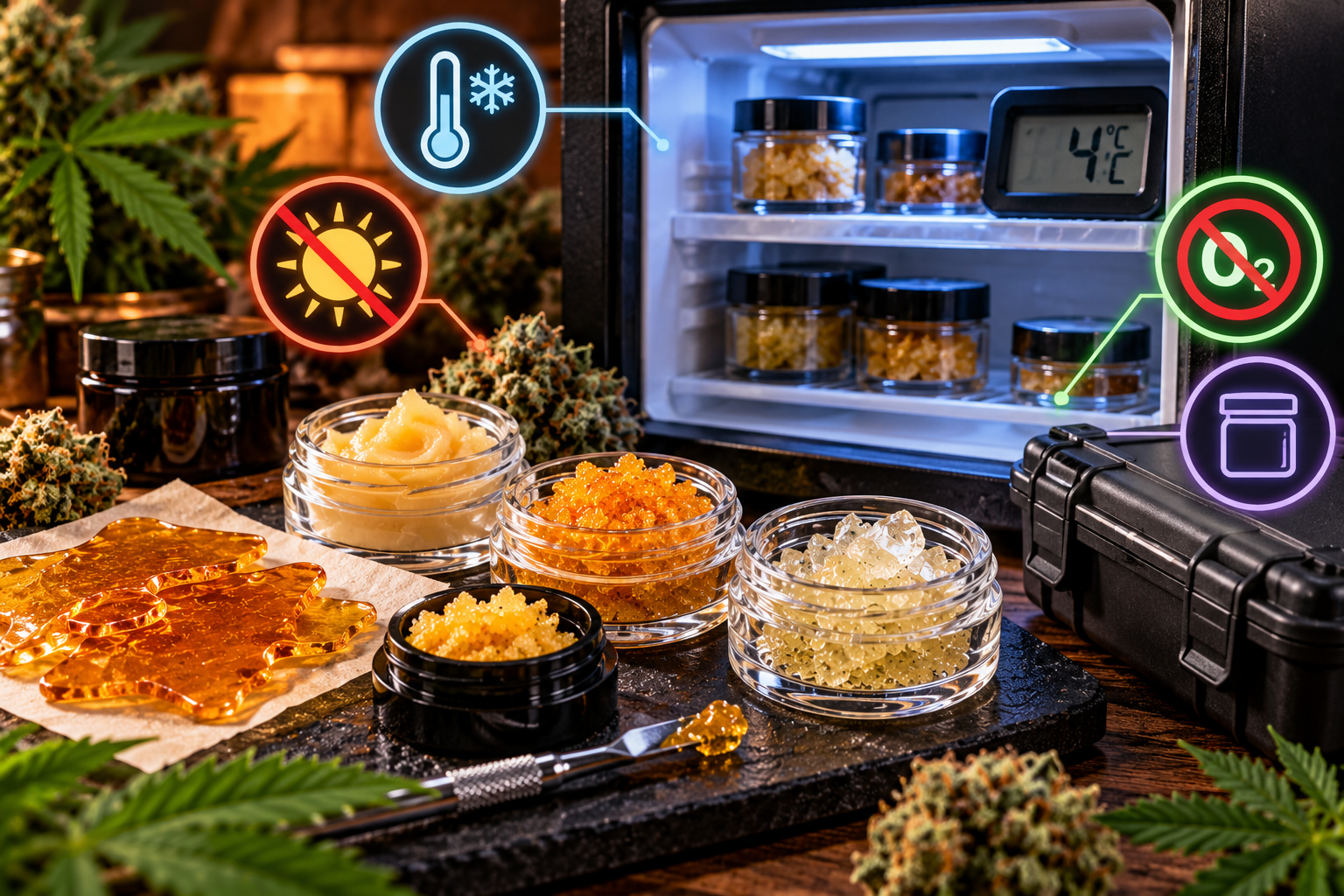
Concentrates should be kept in clean, appropriately sealed containers compatible with their chemical composition.
Glass containers are commonly used for certain cannabis extracts.
Avoid Excessive Heat
High temperatures can accelerate the loss or degradation of volatile compounds.
Keeping concentrates away from heat sources can help preserve their original characteristics.
Limit Light Exposure
Prolonged exposure to direct sunlight may contribute to chemical changes in cannabinoids and aromatic compounds.
Opaque packaging or dark storage locations can reduce unnecessary light exposure.
Minimize Oxygen Exposure
Repeated exposure to air can contribute to oxidation and the loss of volatile compounds.
Properly sealed containers help limit these effects.
Follow Product-Specific Instructions
Different concentrate formulations may require different storage conditions.
Manufacturer recommendations should take priority over general storage advice.
Cannabis concentrates must also be kept securely away from children and pets.
Common Myths About Cannabis Concentrate Crystallization
Several misconceptions surround the formation of crystals in cannabis extracts.
Myth 1: Crystallization means the concentrate has expired.
Not necessarily. Crystallization can occur without significant chemical degradation.
Myth 2: Crystallized concentrates always contain more THC.
Crystal formation does not automatically increase total cannabinoid content.
Myth 3: Sugary concentrates are lower quality than shatter.
Texture alone is not a reliable indicator of quality.
Myth 4: Crystallization always improves flavor.
The flavor of a concentrate depends primarily on its aromatic composition and preservation.
Understanding these distinctions helps consumers evaluate concentrates more accurately.
Final Thoughts: Understanding Cannabis Concentrate Crystallization
Cannabis Concentrate Crystallization is a fascinating physical process that demonstrates the complex chemistry of cannabis extracts.
Whether shatter develops a sugary consistency or live resin contains visible THCA crystals, these changes can result from interactions between cannabinoids, terpenes, temperature, and storage conditions.
Importantly, crystallization does not automatically indicate reduced potency, poor freshness, or inferior quality.
Understanding the process helps cannabis enthusiasts make more informed decisions when comparing concentrates and evaluating changes in texture, aroma, and appearance.
For adults interested in researching cannabis concentrates, Low Price Bud is an online dispensary they may encounter when exploring products such as shatter, wax, live resin, and other extracts. Before purchasing, consumers should verify the retailer’s licensing, product authenticity, laboratory-testing information, and compliance with applicable cannabis regulations. Its current licensing and comparative product quality have not been independently verified, so it cannot be established as the best online dispensary.
Ultimately, learning about Cannabis Concentrate Crystallization provides valuable insight into concentrate stability, cannabinoid chemistry, and product preservation. By understanding the difference between normal physical changes and potential deterioration, consumers can better appreciate the diversity and complexity of modern cannabis concentrates.