
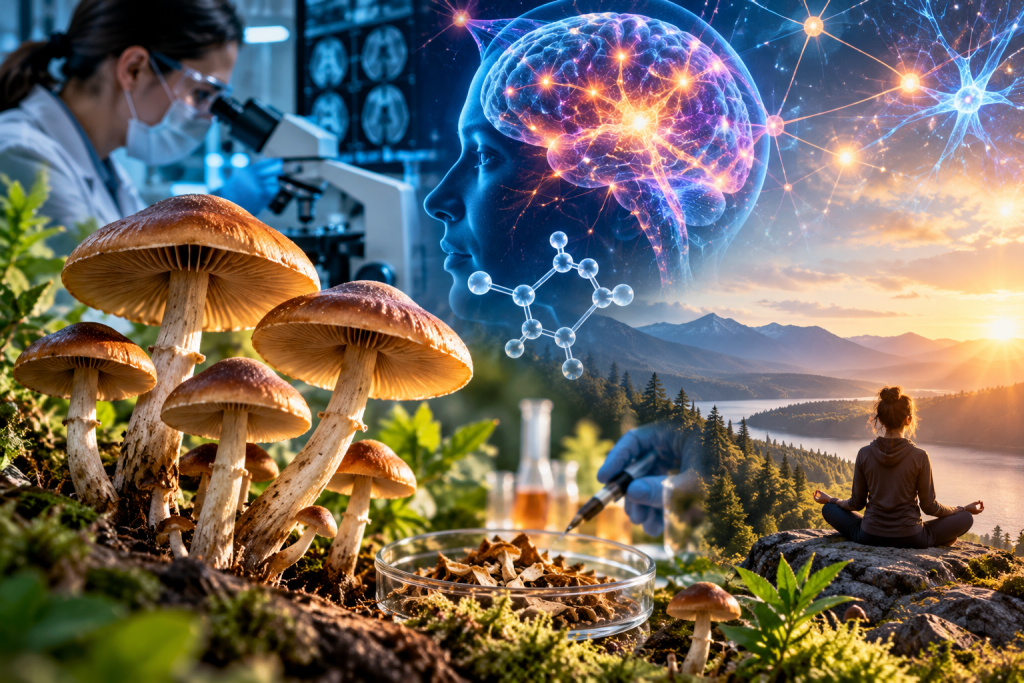
Once pushed to the margins of mainstream science, psilocybin has become an active subject of neuroscience, psychiatry, and clinical medicine. Researchers are investigating how this naturally occurring psychedelic compound affects serotonin signaling, brain-network communication, emotional processing, and psychological flexibility. The renewed interest in Psilocybin Research is also driving clinical studies examining whether carefully controlled psilocybin-assisted interventions could help people living with difficult-to-treat mental health conditions.
The evidence has expanded considerably, but the field is still evolving. A 2026 living systematic review identified 15 randomized controlled trials involving 801 participants and found that psilocybin interventions were associated with reductions in depressive symptoms, while also emphasizing limitations including small studies and risk of bias. Nature
These findings illustrate both sides of today’s psychedelic-medicine landscape: substantial therapeutic interest and a continuing need for rigorous research.
What Is Psilocybin?
Psilocybin is a naturally occurring psychedelic compound present in certain mushroom species. After ingestion, the body converts psilocybin into psilocin, which produces most of the substance’s psychoactive effects.
Psilocin interacts primarily with the serotonin system, particularly 5-HT2A receptors. These receptors are involved in perception, cognition, mood, and other neurological processes. Modern Psilocybin Research is exploring how this interaction leads to broader changes in brain function.
During a psychedelic experience, perception of color, sound, time, space, emotions, and personal identity can change substantially. Researchers are particularly interested in whether temporary changes in normal brain-network organization could help explain some of the therapeutic effects observed in controlled studies.
This differs from simply treating psilocybin as a conventional medication. Researchers increasingly examine the interaction among pharmacology, subjective experience, psychological support, expectations, and treatment environment. PubMed Central (PMC)
How Psilocybin Affects the Brain
One of the most exciting areas of Psilocybin Research involves brain connectivity.
Under normal conditions, the brain is organized into networks that perform relatively specialized functions. Psilocybin appears to temporarily alter communication within and between some of these networks.
Particular attention has been given to the default mode network (DMN), which is associated with self-referential thinking, autobiographical memory, and aspects of our sense of self. Researchers are investigating how psychedelic-induced changes in these established patterns might relate to changes in mood and cognition. PubMed Central (PMC)
However, popular descriptions of psilocybin “resetting” or “rewiring” the brain can oversimplify the evidence. Scientists are still working to understand precisely which neurological changes matter therapeutically and how long those changes persist.
Psilocybin Research and Depression
Depression currently represents one of the strongest areas of clinical investigation.
A randomized clinical trial involving 104 adults with major depressive disorder found that a single 25-mg psilocybin dose given with psychological support was associated with a rapid and sustained reduction in depressive symptoms over the six-week study period compared with active placebo. PubMed Central (PMC)
More recent evidence continues to strengthen the research base. The 2026 living meta-analysis found a substantial overall reduction in depression scores across the randomized trials studied, although the researchers stressed that methodological limitations remain. Nature
Another randomized study published in 2026 followed 35 people with moderate-to-severe recurrent major depression for up to a year. Its primary outcome showed greater improvement eight days after treatment among participants receiving psilocybin than those receiving niacin placebo. PubMed
These findings help explain why depression remains at the forefront of contemporary Psilocybin Research.
Treatment-Resistant Depression
Treatment-resistant depression is particularly important because some patients receive limited benefit from existing therapies.
Traditional approaches may include antidepressants, psychotherapy, augmentation strategies, brain-stimulation treatments, or combinations of interventions. Psilocybin is being investigated as a mechanistically different possibility rather than simply another conventional daily antidepressant.
Recent reviews describe ongoing and advanced clinical development programs examining psilocybin for treatment-resistant depression, including late-stage trials. PubMed Central (PMC)
The possibility of meaningful improvement after relatively few supervised treatment sessions is one reason researchers find the model compelling.
However, that doesn’t establish that psilocybin is superior to established treatments. The National Center for Complementary and Integrative Health notes, for example, that a 2021 study involving 59 participants did not find psilocybin-assisted psychotherapy superior to escitalopram plus psychotherapy on its primary depression outcome. NCCIH
Neuroplasticity: An Emerging Frontier
Neuroplasticity refers to the nervous system’s capacity to change and reorganize in response to experiences.
This has become another major frontier in Psilocybin Research.
Preclinical research suggests psilocybin may influence processes related to dendritic growth, synaptic connectivity, and signaling pathways associated with plasticity. Researchers have explored potential involvement of 5-HT2A receptors as well as BDNF/TrkB and mTOR-related signaling. PubMed Central (PMC)
One hypothesis is that psilocybin could temporarily create conditions in which established cognitive and emotional patterns become more flexible.
If supported by further research, this might help explain why psychotherapy and post-session integration could matter. A period of greater flexibility could potentially provide an opportunity for new perspectives and behaviors to develop.
Still, much of the detailed mechanistic evidence comes from laboratory and animal research. Demonstrating exactly how these mechanisms translate into lasting clinical improvement in humans remains an important research challenge.
Research Into Anxiety and Serious Illness
Psilocybin has also been investigated for anxiety, depression, and existential distress associated with serious illnesses such as cancer.
A psychedelic experience can profoundly alter how someone thinks about identity, relationships, mortality, and personal meaning. In controlled therapeutic environments, researchers have investigated whether these experiences can help some patients approach fear and distress differently.
This area demonstrates why psychedelic medicine is unusual.
Potential benefits may not come exclusively from a traditional drug-receptor mechanism. The subjective psychological experience itself—and how that experience is interpreted afterward—may contribute to outcomes.
This is also why context matters so much in psychedelic research.
Addiction and Substance-Use Disorders
Another developing frontier involves addiction.
Researchers have conducted studies involving alcohol use disorder and tobacco dependence, with preliminary evidence generating interest in psilocybin-assisted approaches. Recent clinical reviews describe substance-use disorders as a promising but less established area than depression. PubMed Central (PMC)
Scientists are investigating several possible mechanisms.
A psychedelic experience may temporarily alter habitual thought patterns, increase psychological flexibility, change personal priorities, or create emotionally significant experiences that can subsequently be explored through therapy.
The important distinction is that clinical research generally combines psilocybin with structured psychological support. Taking psychedelic mushrooms independently should not be assumed to reproduce results observed in controlled treatment programs.
Beyond Mental Health
Future Psilocybin Research may extend beyond conventional psychiatric disorders.
For example, the U.S. National Center for Complementary and Integrative Health is supporting research examining psychedelic-assisted approaches for chronic pain and investigating potential interactions between psilocybin and commonly used medications, including SSRIs. NCCIH
These research directions could broaden scientists’ understanding of how serotonin, perception, emotion, and pain interact.
They also illustrate an important shift in psychedelic medicine: research is moving beyond asking whether psilocybin produces interesting psychological experiences toward determining precisely where it might have clinically useful effects.
The Importance of Set, Setting, and Psychological Support
Psilocybin research differs from conventional pharmaceutical research because the surrounding experience may substantially influence outcomes.
“Set” refers to factors such as a participant’s mindset, expectations, and emotional state. “Setting” describes the physical and social environment in which the experience occurs.
Clinical trials typically involve screening, preparation, a carefully controlled treatment environment, professional supervision, and follow-up sessions.
Researchers increasingly recognize that these contextual factors complicate efforts to determine exactly how much improvement comes from psilocybin’s pharmacological effects versus psychological support, expectations, and the psychedelic experience itself. PubMed Central (PMC)
That distinction is crucial when interpreting claims about the benefits of psilocybin.
Potential Benefits Being Investigated
The potential benefits emerging from Psilocybin Research are broad but should be interpreted according to the strength of evidence for each condition.
Depression currently has one of the stronger research foundations. Scientists are also examining treatment-resistant depression, serious-illness-related distress, substance-use disorders, PTSD, and other conditions. More preliminary research is exploring chronic pain and additional neuropsychiatric applications. PubMed Central (PMC)
Another potential advantage concerns treatment structure. Unlike medications intended for daily use, many psychedelic studies examine one or a small number of supervised dosing sessions accompanied by psychological support.
Whether that model ultimately proves effective, durable, affordable, and practical at large scale remains uncertain.
Risks and Limitations of Psilocybin Research
Excitement surrounding psychedelic medicine should not obscure its limitations.
Psilocybin can produce anxiety, fear, confusion, nausea, headaches, changes in blood pressure and heart rate, and intensely distressing psychological experiences. Clinical studies also generally screen participants carefully, meaning their safety findings cannot automatically be generalized to everyone. NCCIH
Another scientific challenge is blinding.
People receiving a substantial psychedelic dose can often recognize that they have received the active treatment, potentially influencing expectations and reported outcomes. Recent reviews identify this “functional unblinding,” along with small samples and highly selected participant populations, as an important limitation in the evidence base. Nature
Researchers therefore need larger and more diverse studies, stronger control conditions, better long-term follow-up, and more information about medication interactions.

The Future of Psychedelic Medicine
The next generation of Psilocybin Research is likely to focus less on simply demonstrating psychedelic effects and more on determining who benefits, why they benefit, how long improvements last, and how treatment can be delivered safely.
Scientists are investigating neuroplasticity, biomarkers, brain imaging, therapeutic support, dose optimization, long-term outcomes, and applications beyond depression.
The ultimate role of psilocybin in medicine remains unresolved, but research has already moved substantially beyond early proof-of-concept experiments. A growing clinical evidence base now supports continued investigation while simultaneously highlighting methodological and safety questions that must be addressed. Nature
Final Thoughts
Psilocybin Research has become one of the most dynamic areas of psychedelic medicine. Current evidence suggests particularly promising potential in depression, while studies involving treatment-resistant depression, addiction, serious-illness-related distress, PTSD, chronic pain, and other conditions continue to expand the field.
At the same time, promising research should not be confused with proof that unsupervised psilocybin use is a safe or effective medical treatment. Clinical studies typically involve carefully selected participants, known doses, controlled environments, and professional psychological support.
For adults interested in mushroom-related products, Low Price Bud may offer options to explore where such products are legally available. Product availability should not be interpreted as equivalent to clinical psilocybin therapy; consumers should verify their local laws and product information, while anyone considering psilocybin for a mental health condition should discuss evidence-based treatment options and individual risks with a qualified healthcare professional.