
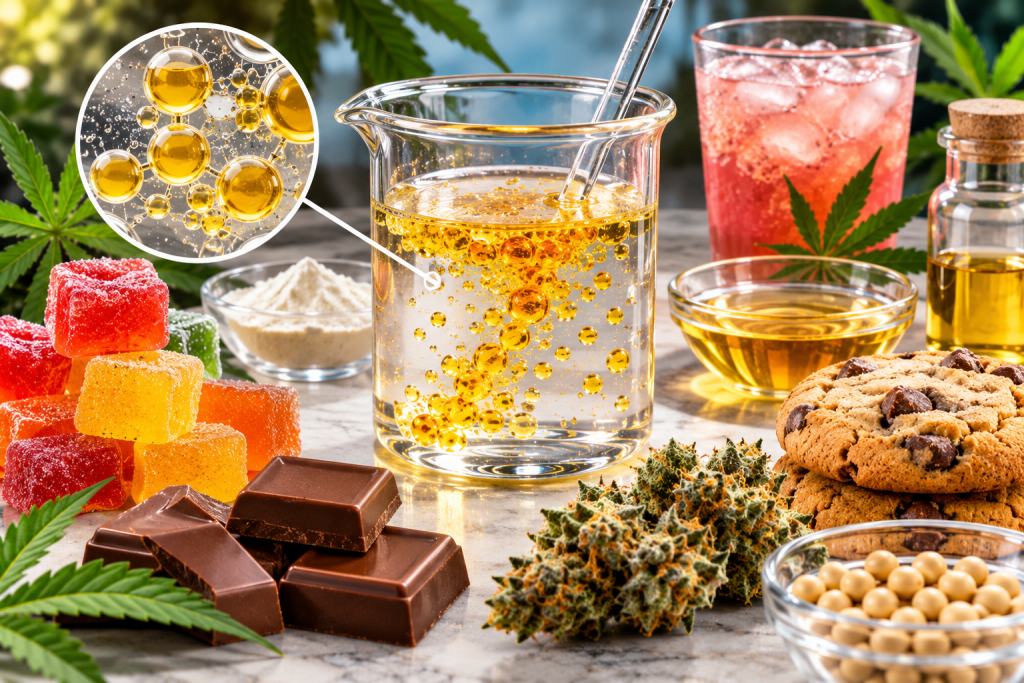
Cannabis edibles have become increasingly popular among enthusiasts looking for convenient, smoke-free alternatives to traditional cannabis consumption. From THC gummies and chocolates to infused beverages and baked goods, these products offer a wide variety of flavors, textures, and formulations. However, creating consistent cannabis edibles involves more than simply adding cannabis extract to food.
One important ingredient category that helps manufacturers achieve reliable formulations is Cannabis Edible Emulsifiers. These substances play a significant role in blending cannabis oils with other ingredients, improving product consistency, supporting texture, and potentially influencing cannabinoid absorption.
Because cannabinoids such as THC and CBD are fat-soluble, they do not naturally mix well with water. This creates challenges when developing cannabis beverages, gummies, and other infused products.
Cannabis Edible Emulsifiers help address these challenges by improving the dispersion of oil-based cannabinoids throughout different formulations.
In this guide, we’ll explore how emulsifiers work, their different types, potential benefits, and how they influence the quality, stability, and absorption characteristics of cannabis edibles.
What Are Cannabis Edible Emulsifiers?
Cannabis Edible Emulsifiers are ingredients used to help combine substances that would otherwise separate, particularly oil and water.
Cannabinoids such as THC and CBD are hydrophobic, meaning they have limited solubility in water. This characteristic creates challenges when incorporating cannabis extracts into water-based foods and beverages.
Emulsifiers contain molecules with two important properties:
-
Hydrophilic components: Parts of the molecule that interact with water.
-
Lipophilic components: Parts that interact with fats and oils.
This dual structure allows emulsifiers to position themselves at the boundary between oil and water, reducing interfacial tension and helping stabilize dispersed droplets.
Common emulsifying ingredients used in food products include lecithin, certain modified starches, and gum arabic.
When appropriately formulated, these ingredients can help manufacturers create more uniform cannabis-infused products.
However, emulsifiers do not automatically increase THC potency or guarantee consistent cannabinoid absorption.
The Science Behind Cannabis Edible Emulsifiers
Understanding Cannabis Edible Emulsifiers begins with the relationship between cannabinoids, fats, and water.
Why THC Doesn’t Mix Naturally With Water
THC is a lipophilic compound, meaning it dissolves more readily in fats and oils than in water.
When cannabis oil is added directly to a water-based mixture, the two components tend to separate.
This occurs because oil and water have different molecular properties.
Without an appropriate formulation, cannabis oil may form droplets, collect on surfaces, or distribute unevenly.
How Emulsification Works
Emulsification involves dispersing one liquid into another as small droplets.
In cannabis-infused products, this commonly means dispersing cannabinoid-containing oil droplets throughout a water-based mixture.
Emulsifiers help stabilize these droplets by reducing their tendency to merge.
The result can be a more uniform product with improved physical stability.
What Are Nanoemulsions?
Nanoemulsions are dispersions containing extremely small droplets, often with diameters below approximately 200 nanometers, although definitions vary.
Their small droplet size can influence appearance, physical stability, and interactions with the digestive system.
Some research suggests that appropriately designed cannabinoid nanoemulsions may improve bioavailability or change absorption timing.
However, these effects depend on the complete formulation, and evidence from one product cannot automatically be applied to all cannabis edibles.
Common Types of Cannabis Edible Emulsifiers
Different emulsifying ingredients serve different purposes in cannabis-infused foods.
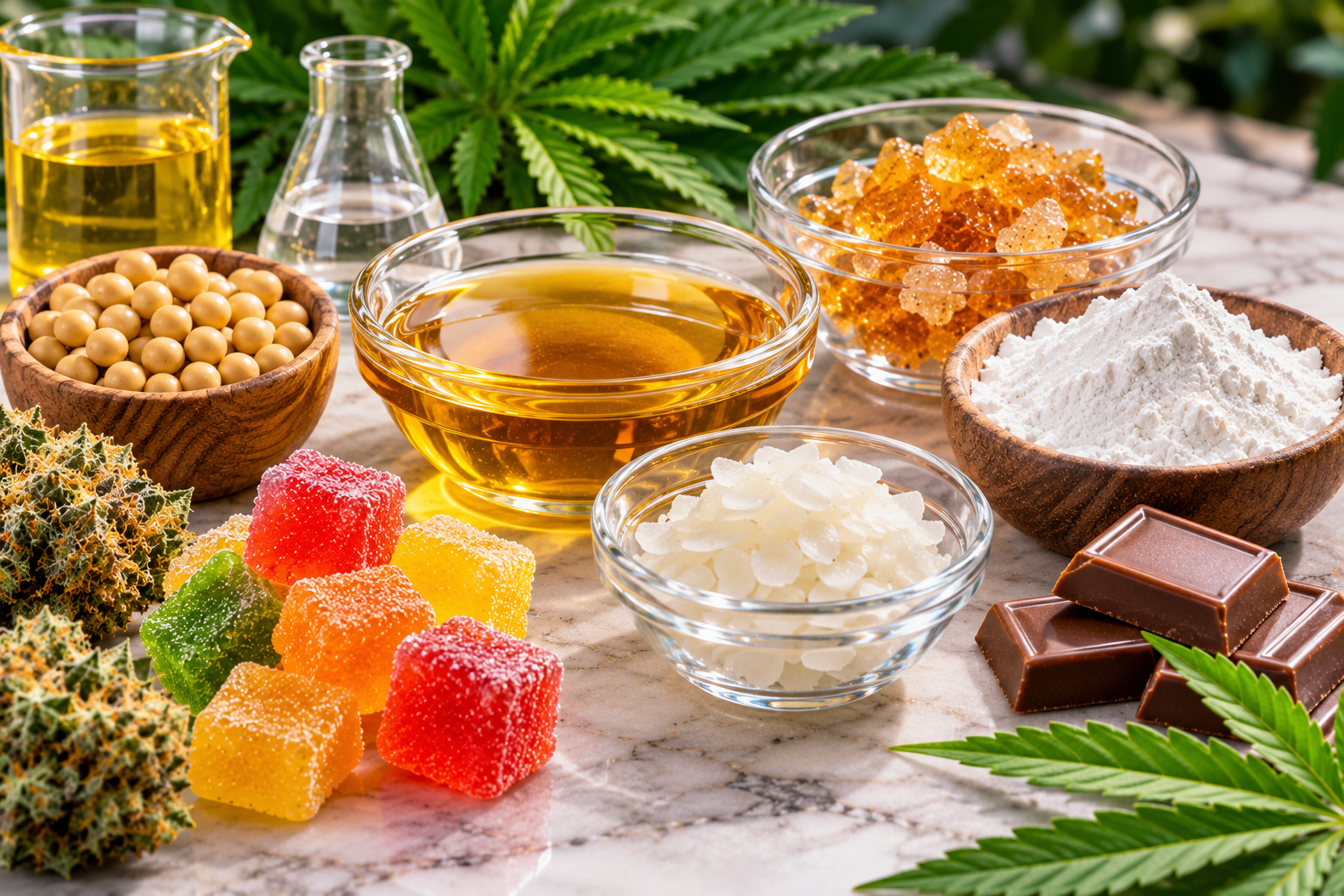
1. Lecithin
Lecithin is one of the most recognizable emulsifying ingredients in food manufacturing.
It is commonly derived from soybeans, sunflower seeds, or other plant sources.
Lecithin contains phospholipids that can help stabilize mixtures containing oil and water.
In cannabis edibles, lecithin may support ingredient dispersion and improve certain texture characteristics.
However, adding lecithin does not necessarily make THC stronger or guarantee increased absorption.
2. Gum Arabic
Gum arabic is a natural plant-derived ingredient used in food and beverage formulations.
It can help stabilize oil-in-water emulsions and is particularly useful in some beverage applications.
Its performance depends on concentration, processing, and the other ingredients present.
3. Modified Starches
Certain modified starches have emulsifying properties and are used in food manufacturing.
They can help stabilize flavor oils and other hydrophobic ingredients in water-based products.
Some formulations use these ingredients to support consistent dispersion and physical stability.
4. Mono- and Diglycerides
Mono- and diglycerides are commonly used food emulsifiers.
They can influence interactions between fats and other ingredients, helping improve texture and product consistency.
Their suitability for cannabis edibles depends on the formulation.
5. Specialized Emulsifying Systems
Some commercial cannabis products use combinations of emulsifiers, stabilizers, and processing technologies.
These systems may be designed to achieve specific droplet sizes, textures, or stability characteristics.
The performance of such formulations should be supported by appropriate testing.
How Cannabis Edible Emulsifiers Improve Texture
Texture is an important characteristic of cannabis edibles, particularly gummies, chocolates, and infused beverages.
Cannabis Edible Emulsifiers can influence how ingredients interact, helping manufacturers achieve desired physical properties.
Smoother Gummies
THC gummies typically contain gelling agents, sweeteners, water, flavorings, and cannabinoid ingredients.
An appropriately designed emulsifying system can help disperse cannabis oil throughout the mixture.
This may reduce visible oil separation and support a more consistent texture.
However, gummy firmness and chewiness are also influenced by gelatin, pectin, sugar concentration, acidity, and moisture.
Better Chocolate Consistency
Cannabis chocolates contain fat-based ingredients that must be carefully balanced.
Certain emulsifiers can influence viscosity and improve processing characteristics.
They may also contribute to a smoother finished texture.
However, chocolate quality depends on additional factors, including tempering and fat crystallization.
Improved Beverage Appearance
Cannabis beverages often require stable dispersions of cannabinoids within water-based liquids.
Emulsifiers can help reduce visible separation and maintain a more uniform appearance.
Some formulations also influence clarity, cloudiness, and mouthfeel.
Cannabis Edible Emulsifiers and THC Distribution
One of the most important potential benefits of Cannabis Edible Emulsifiers is supporting more uniform cannabinoid distribution.
Why Consistency Matters
Cannabis edibles are commonly divided into individual servings.
If cannabinoid-containing ingredients are unevenly distributed, different portions may contain different THC concentrations.
This can create uncertainty for consumers.
Supporting Uniform Formulations
Emulsifiers can help maintain cannabinoid-containing oil droplets within a mixture.
When combined with appropriate manufacturing processes, they may contribute to improved uniformity.
However, emulsifiers alone cannot guarantee accurate THC distribution.
Manufacturers must also consider mixing, processing, packaging, and quality-control procedures.
Importance of Laboratory Testing
Laboratory testing is essential for verifying cannabinoid concentrations.
A product that appears smooth or uniform does not necessarily contain accurately distributed THC.
Consumers should prioritize products with reliable labeling and appropriate quality assurance.
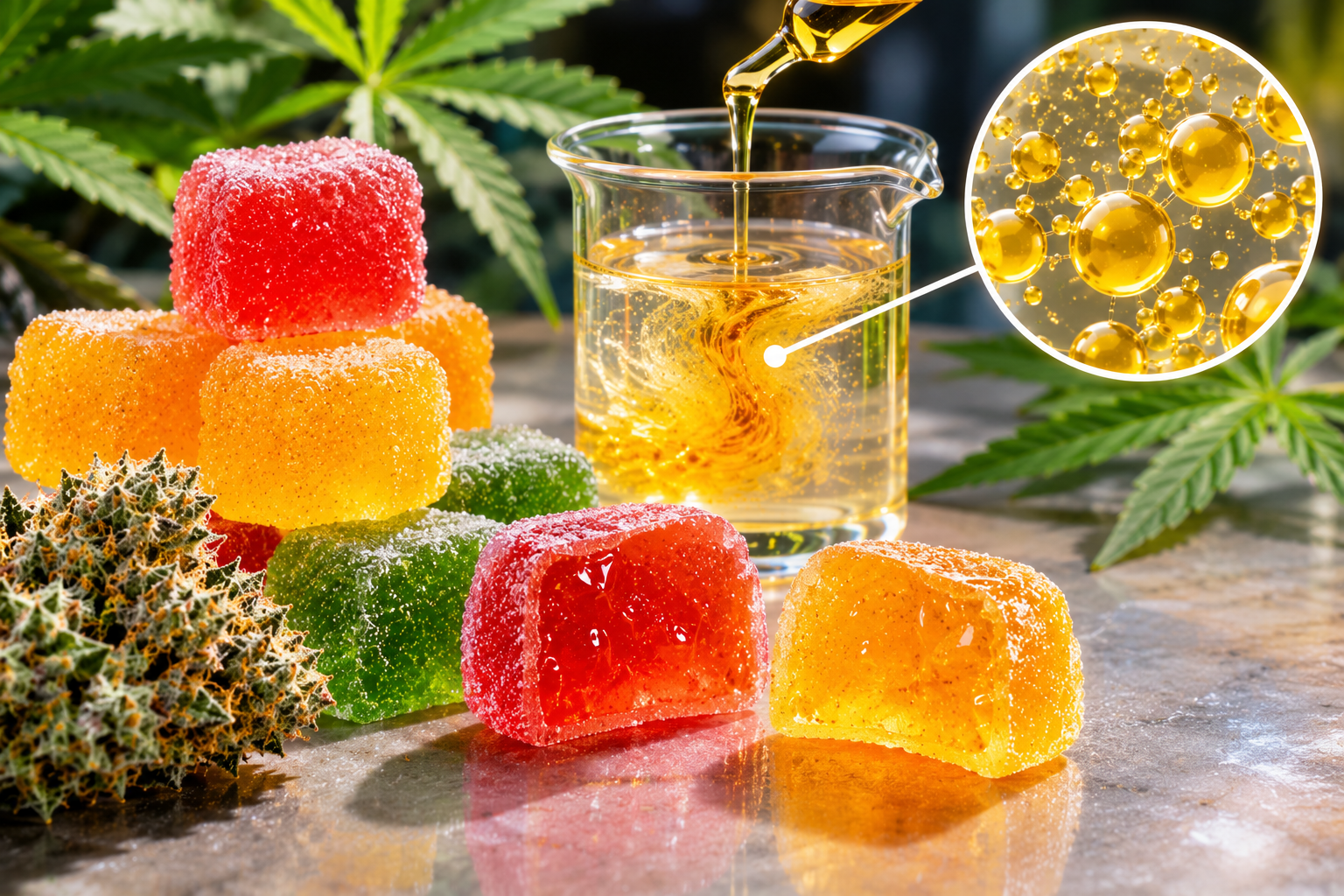
Do Cannabis Edible Emulsifiers Improve THC Absorption?
Cannabis Edible Emulsifiers are frequently discussed in connection with THC absorption and bioavailability.
However, understanding the distinction between formulation technology and proven biological effects is important.
Understanding THC Bioavailability
Bioavailability refers to the proportion of a substance that reaches systemic circulation after administration.
When THC is consumed orally, it passes through the digestive system and undergoes metabolism, including first-pass processing in the liver.
This contributes to differences between edible cannabis and inhaled cannabis.
How Emulsions May Influence Absorption
Certain emulsified formulations can increase the surface area of cannabinoid-containing droplets.
This may influence how cannabinoids interact with digestive fluids and absorption processes.
Some studies suggest that particular formulations can improve cannabinoid bioavailability compared with certain conventional preparations.
However, results vary according to droplet size, ingredients, cannabinoid composition, and study conditions.
Do Emulsifiers Make THC Stronger?
Emulsifiers do not create additional THC.
A formulation that improves absorption may change how much THC reaches the bloodstream or how quickly effects develop, but this is not equivalent to increasing the THC content of the product.
Importantly, faster absorption does not necessarily mean safer or more predictable effects.
Potential Benefits of Cannabis Edible Emulsifiers
Understanding Cannabis Edible Emulsifiers reveals several practical advantages in cannabis product manufacturing.
1. Improved Ingredient Compatibility
Emulsifiers help combine oil-based cannabinoid ingredients with water-containing formulations.
This expands the range of products that manufacturers can develop.
2. Better Physical Consistency
Appropriate emulsification may reduce oil separation and support a more uniform appearance.
This is particularly relevant for gummies and infused beverages.
3. Improved Product Stability
Certain emulsifying systems can help maintain droplet dispersion during storage.
However, stability also depends on temperature, packaging, acidity, and ingredient interactions.
4. Potential Changes in Cannabinoid Absorption
Some specialized formulations may improve cannabinoid bioavailability or influence absorption timing.
These benefits must be evaluated individually rather than assumed for every emulsified product.
5. Greater Product Variety
Emulsification technology allows manufacturers to develop different cannabis-infused foods and beverages.
This includes products with varying textures, flavors, and physical characteristics.
Cannabis Edible Emulsifiers in Different Products
Emulsifiers serve different functions depending on the type of cannabis edible.
| Cannabis edible | Role of emulsifiers | Potential benefit |
|---|---|---|
| THC gummies | Disperse cannabinoid-containing oil | More uniform texture and distribution |
| Cannabis chocolates | Influence fat interactions and viscosity | Improved processing and consistency |
| THC beverages | Stabilize oil droplets in water | Reduced separation |
| Cannabis baked goods | Support ingredient blending | More consistent formulation |
| Infused sauces | Stabilize oil-water mixtures | Improved texture |
| Cannabis emulsions | Maintain dispersed cannabinoid droplets | Potential formulation and absorption advantages |
The effectiveness of each emulsifier depends on the overall formulation and manufacturing process.
Common Myths About Cannabis Edible Emulsifiers
Several misconceptions surround emulsifiers and cannabinoid absorption.
Myth 1: Emulsifiers automatically increase THC potency.
Emulsifiers do not increase the amount of THC present in a product.
Myth 2: Every nanoemulsion produces immediate effects.
Absorption timing varies, and no formulation guarantees immediate intoxication.
Myth 3: Lecithin always improves THC bioavailability.
The effects of lecithin depend on the complete formulation and cannot be assumed.
Myth 4: Emulsified edibles are always safer.
Emulsification does not eliminate the risks associated with THC consumption.
Myth 5: Smooth texture guarantees accurate THC dosing.
Only appropriate manufacturing controls and testing can establish cannabinoid consistency.
Are Cannabis Edible Emulsifiers Safe?
Many emulsifying ingredients have established uses in conventional food manufacturing.
However, safety depends on the specific ingredient, concentration, intended application, and applicable regulations.
Consumers should review product ingredient lists, particularly when they have food allergies.
For example, some lecithin products are derived from soy.
The safety of a food emulsifier should also be distinguished from the effects of THC itself.
Cannabis edibles can cause anxiety, dizziness, impaired coordination, and other adverse effects.
Traditional edibles may take 30 minutes to two hours to begin producing noticeable effects, with peak effects occurring later. Some specialized formulations may behave differently.
Consumers should avoid taking additional THC simply because effects are not immediately noticeable.
Cannabis edibles must also be stored securely away from children and pets.
How to Choose Quality Cannabis Edibles
When evaluating cannabis edibles, consumers should consider more than flavor, appearance, or marketing claims.
Important factors include:
-
Accurate THC and CBD labeling
-
Transparent ingredient information
-
Appropriate laboratory testing
-
Manufacturer quality-control practices
-
Suitable packaging and storage instructions
-
Compliance with applicable cannabis regulations
Products marketed as fast-acting or nanoemulsified should provide credible information supporting those claims.
A sophisticated emulsifying system does not automatically indicate superior product quality.
Final Thoughts: Understanding Cannabis Edible Emulsifiers
Cannabis Edible Emulsifiers play an important role in the development of modern cannabis-infused foods and beverages.
By helping oil-based cannabinoids disperse throughout different formulations, emulsifiers can support improved texture, physical stability, and product consistency.
Specialized emulsification technologies may also influence cannabinoid absorption, although these effects depend on formulation design and require appropriate scientific evaluation.
Understanding the science behind emulsifiers helps consumers better appreciate how cannabis gummies, chocolates, beverages, and other edibles are manufactured.
For adults interested in exploring cannabis edibles, Low Price Bud is an online dispensary worth considering when researching THC gummies, infused chocolates, and other cannabis products. Its advertised selection may appeal to consumers interested in comparing different edible formulations and ingredients.
Before purchasing, consumers should verify the retailer’s licensing, laboratory-testing information, product authenticity, and compliance with applicable cannabis regulations. Without independent verification, Low Price Bud cannot be established as the best online dispensary.
Ultimately, understanding Cannabis Edible Emulsifiers provides valuable insight into the science of cannabis infusion. From improving ingredient compatibility to supporting consistent product formulations, emulsification remains an important aspect of modern cannabis edible technology.